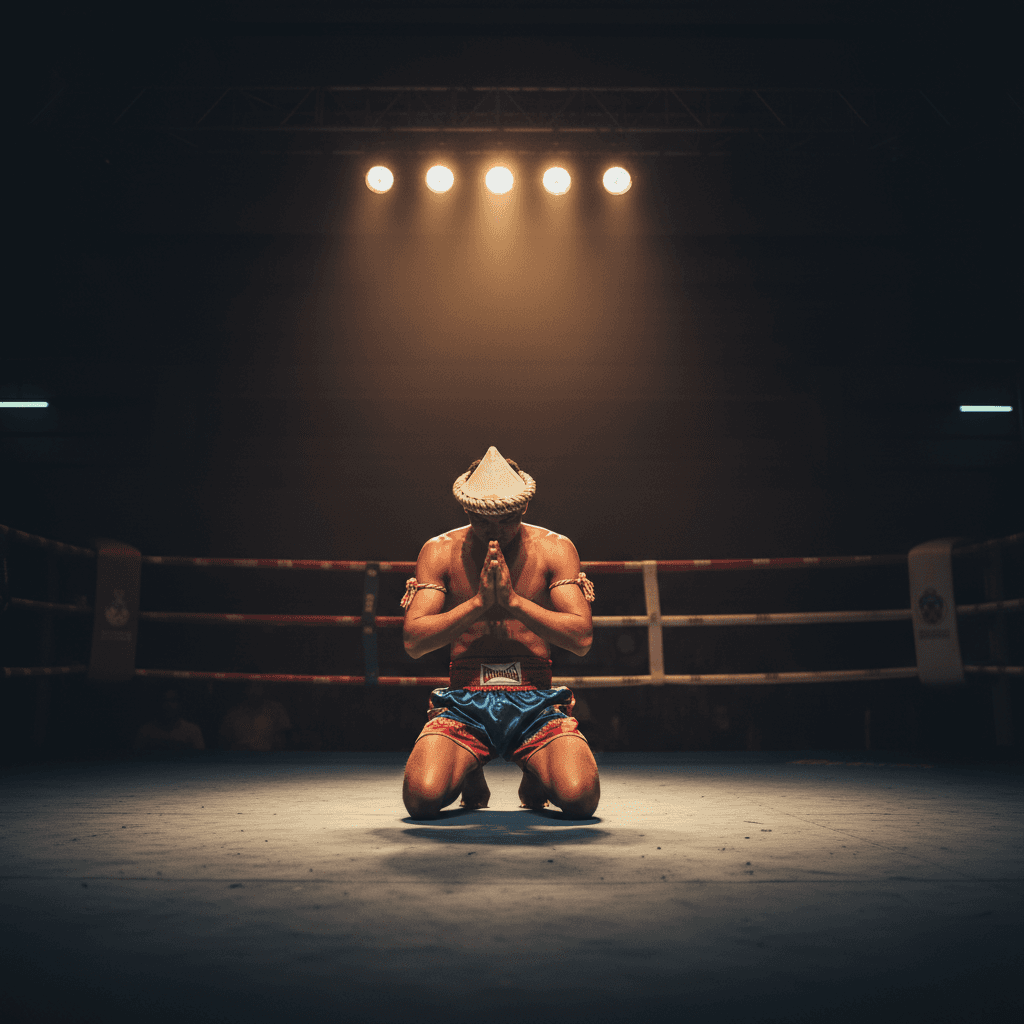
What Is the Wai Kru Ram Muay?
The Wai Kru Ram Muay is the ritualistic ceremony performed by every Kun Khmer fighter before a bout begins. It is, without exaggeration, one of the most important elements of Cambodian boxing — as central to the art as any technique, combination, or fighting strategy. To watch a Kun Khmer event without the Wai Kru would be like attending a Buddhist ceremony without the chanting: technically possible, but spiritually hollow and culturally meaningless.
The name itself reveals its purpose. Wai Kru (ថ្វាយគ្រូ) translates literally as "paying respect to the teacher." This is the ceremony's primary function: an act of gratitude and reverence toward the fighter's Kru (master), the Kru's teachers before them, and the entire lineage of masters who have preserved and transmitted Kun Khmer through the centuries. Ram Muay (រាំមួយ) means "the boxing dance" — the specific choreographed movements that each fighter performs as part of the ritual.
But the Wai Kru is far more than a gesture of thanks. It is a spiritual act of preparation that encompasses multiple functions simultaneously. It invokes the protection of spiritual guardians — Buddhist, Hindu, and animist spirits that the fighter believes watch over them. It seals the ring, creating a sacred space in which the bout will take place. It demonstrates the fighter's training lineage to those who can read the movements. It focuses the fighter's mind, transitioning them from the ordinary world into the heightened state of awareness required for combat. And it pays respect to the art itself, acknowledging that Kun Khmer is something greater than any individual practitioner.
Every fighter performs the Wai Kru before every bout, regardless of the significance of the event. Whether it is a stadium championship broadcast to millions or an undercard bout in a provincial town, the ritual is performed with the same sincerity and attention. A fighter who performs a careless or disrespectful Wai Kru brings shame upon their Kru and their camp. Conversely, a beautifully performed Wai Kru can elevate a fighter's reputation even before the first punch is thrown, demonstrating the depth of their training and the quality of their character.
The Mongkol Blessing Process
The ceremony begins not in the ring but in the fighter's corner, with the placing of the Mongkol (មង្គល) — the sacred headband that is perhaps the most revered object in Kun Khmer culture. The Mongkol is not merely an accessory. It is a consecrated spiritual artifact, blessed by Buddhist monks or the fighter's Kru through a process that may involve chanted Pali sutras, holy water, and sacred inscriptions. Each Mongkol is unique to the gym that owns it, and some Mongkols have been in use for decades, accumulating spiritual power with each ceremony.
The Mongkol is traditionally kept in an elevated position in the gym — never placed on the ground, never stepped over, never handled by anyone other than the Kru or the fighter to whom it is entrusted. Before a fight, the Kru places the Mongkol on the fighter's head while reciting prayers or mantras specific to their lineage. This moment is profoundly intimate. The Kru may blow on the Mongkol, transferring spiritual energy. They may whisper specific instructions or blessings into the fighter's ear. The fighter kneels or bows their head to receive the headband, and the act of placement symbolizes the transference of the Kru's protection and accumulated spiritual merit to the student.
In some camps, the Mongkol blessing also involves the application of nam mon — sacred oil blessed by monks — to the fighter's forehead, shoulders, and chest. The oil is believed to create a spiritual barrier against harm. Other camps use sacred water or ground herbal preparations. The specific practices vary by lineage, and these variations are closely guarded traditions that distinguish one camp from another.
The Mongkol remains on the fighter's head throughout the entire Wai Kru ceremony. It is removed only after the ritual is complete, just before the fight begins. The Kru removes it personally, again reciting prayers, and stores it safely in the fighter's corner. Under no circumstances should the Mongkol fall to the ground during the ceremony — this is considered an extremely bad omen and a sign of spiritual vulnerability.
Entering the Ring: Circumambulation and the Ropes
The fighter's entrance into the ring is itself a ritual act, governed by specific protocols that vary somewhat between camps and lineages but share common elements rooted in spiritual belief. The process begins with the fighter approaching the ring from their designated corner, typically accompanied by their Kru and cornermen.
Before entering, the fighter performs a Sampeah — the traditional Khmer gesture of pressing the palms together at the forehead level — directed toward the ring. This gesture acknowledges the ring as a sacred space and asks permission from the spiritual guardians to enter. The height of the hands in the Sampeah indicates the level of respect: hands at the forehead represent the highest level, appropriate for sacred objects and spiritual entities.
The method of entering the ring carries specific meaning. Fighters traditionally step over the top rope rather than ducking through the middle ropes. This practice has spiritual significance: the ropes define the boundary of the sacred fighting space, and stepping over them — ideally without touching them — demonstrates respect for that boundary. If a fighter must touch the ropes, they should do so with the upper body, never stepping on the bottom rope. The specific foot used to enter the ring and the direction the fighter faces while entering may also be dictated by tradition: many fighters enter leading with the right foot, which is considered auspicious in Cambodian culture.
Once inside the ring, the fighter performs the circumambulation — a circuit of the ring performed in a counter-clockwise direction. Walking the perimeter of the ring serves multiple purposes. Practically, it allows the fighter to survey the space, noting the condition of the canvas, the tension of the ropes, and the position of the corners. Spiritually, it is an act of claiming and consecrating the space. With each step, the fighter is believed to be sealing the ring, establishing spiritual boundaries that protect against malevolent influences and contain the sacred energy of the bout within the roped enclosure.
During the circumambulation, the fighter pauses at each corner to perform a brief prayer or gesture. In some traditions, the fighter touches the corner post and bows, acknowledging the cardinal directions and the spiritual forces associated with each. This practice has roots in Hindu-Buddhist cosmology, where the four directions correspond to specific deities and protective forces. By saluting each corner, the fighter invokes protection from all directions.
The Ram Muay Dance
The Ram Muay is the centerpiece of the Wai Kru ceremony — the choreographed dance that gives the ritual its visual power and emotional intensity. Performed to the live accompaniment of the Pinpeat orchestra, the Ram Muay is a sequence of movements that combines martial gesture, spiritual invocation, and artistic expression into a performance that is uniquely and unmistakably Cambodian.
The Ram Muay begins with the fighter kneeling in the center of the ring, facing the direction of their Kru. The fighter performs three bows to the ground — forehead touching the canvas — while the Pinpeat plays a specific introductory passage. These bows represent respect to three entities, though their specific attribution varies by lineage. Common interpretations include: respect to the Buddha, the Dharma, and the Sangha (the Buddhist Triple Gem); respect to the Kru, the parents, and the nation; or respect to the earth, the ancestors, and the spiritual guardians. The sincerity of these bows sets the tone for the entire ceremony.
After the initial bows, the fighter rises and begins the standing portion of the Ram Muay. This is where individual and camp-specific choreography becomes apparent. While the overall structure of the Ram Muay follows recognizable patterns, the specific movements vary significantly between lineages, and experienced observers can identify a fighter's training camp by watching their Ram Muay alone.
Common elements of the standing Ram Muay include:
The Angkor Salute: Arms extended to the sides with palms facing upward, then brought together overhead in an arc — a movement that echoes the gestures of Apsara dancers depicted in Angkorian temple carvings. This element connects the fighter to the artistic and spiritual heritage of the Khmer Empire.
The Warrior's Gaze: The fighter shades their eyes with one hand and scans the horizon in all four directions. This gesture symbolizes surveying the battlefield, assessing threats, and demonstrating alertness and readiness. It is both a martial and spiritual act — acknowledging the physical opponent while also scanning for spiritual dangers.
The Naga Step: A serpentine walking pattern that references the Naga, the mythical serpent of Khmer mythology that serves as a protective guardian. The fighter moves in sinuous, flowing patterns that contrast with the explosive directness of fighting movement, demonstrating grace and control.
Locking the Ring: Perhaps the most significant spiritual element of the Ram Muay. The fighter makes specific gestures toward each corner and along each side of the ring, symbolically sealing the fighting space against negative spiritual influences. In some traditions, the fighter stamps the canvas at specific points, driving spiritual "stakes" into the ground to establish a protective barrier. Other fighters trace invisible symbols in the air — sacred geometries derived from Hindu-Buddhist yantra traditions — that create a spiritual shield around the ring.
Signature Movements: Each camp and lineage incorporates distinctive movements into their Ram Muay that serve as a kind of martial signature. These may reference the camp's geographical origin, its founding Kru, a patron animal spirit, or specific fighting techniques that the camp is known for. An experienced observer can read these movements like a language, understanding the fighter's lineage, training emphasis, and spiritual affiliations from the choreography alone.
Combat Pantomime: Many Ram Muay sequences include movements that pantomime actual fighting techniques — shadow strikes, blocks, and evasive movements performed slowly and deliberately. These gestures serve to warm up the body while also demonstrating the fighter's technical repertoire to the audience and the spiritual world. They declare: "These are my weapons. This is what I am prepared to do."
The duration of the Ram Muay varies but typically lasts between three and five minutes. The Pinpeat orchestra follows the fighter's movements, the Sampho drummer adjusting the tempo to match the rhythm of the dance. The interplay between fighter and musicians is dynamic and responsive — an experienced Sampho player can read a fighter's movements and anticipate transitions, while a skilled fighter can use the music to enhance the dramatic impact of their performance.
Spiritual Beliefs Surrounding the Wai Kru
The spiritual dimension of the Wai Kru is not metaphorical or symbolic in the mind of most Cambodian fighters — it is literal and immediate. The beliefs that underpin the ceremony represent a syncretism of Theravada Buddhism, Brahmanist Hinduism, and indigenous Khmer animism that has developed over centuries of cultural blending.
Fighters genuinely believe that the Wai Kru establishes a protective spiritual field around them for the duration of the bout. This protection is understood to operate through multiple mechanisms: the merit transferred from the Kru through the Mongkol, the blessings of ancestral spirits invoked during the Ram Muay, the sealing of the ring against malevolent influences, and the focused spiritual intention of the fighter's prayers. A fighter who performs the Wai Kru with genuine devotion enters the fight feeling spiritually armored. A fighter who performs it perfunctorily enters the fight feeling exposed.
Many fighters also believe that the Wai Kru can influence the outcome of the fight through spiritual channels that transcend physical ability. A fighter whose spiritual practice is strong, whose relationship with their Kru is healthy, and whose conduct has been virtuous is believed to carry a spiritual advantage that can manifest as enhanced reflexes, unexpected stamina, or favorable fortune in close exchanges. Conversely, a fighter who has behaved badly, disrespected their Kru, or neglected their spiritual obligations may find that their physical skills are mysteriously diminished.
Krueng Rang — amulets and talismans — are frequently incorporated into the Wai Kru ceremony. These may include small Buddha images, inscribed metal tablets, blessed strings, or other objects that have been consecrated by monks or spiritual specialists. Some fighters have elaborate collections of Krueng Rang, each believed to provide specific protections or powers. The amulets may be worn during the ceremony and then removed before fighting, or they may be present in the fighter's corner throughout the bout, radiating protective energy.
The spiritual beliefs of the Wai Kru are not diminishing in the modern era. Even among fighters who have exposure to Western training methods, sports science, and secular worldviews, the Wai Kru retains its spiritual authority. This is not a contradiction — it reflects the Cambodian understanding that physical and spiritual reality operate simultaneously, and that a fighter who trains only the body while neglecting the spirit is fundamentally incomplete.
How the Khmer Wai Kru Differs from the Thai Wai Kru
Given the historical and technical connections between Kun Khmer and Muay Thai, the pre-fight ceremonies of both arts share obvious structural similarities. Both involve paying respect to teachers, performing a ritualistic dance, wearing sacred headbands, and fighting to live traditional music. However, meaningful differences distinguish the two traditions, and understanding these differences is important for appreciating the unique identity of each art.
Musical accompaniment: The Khmer Wai Kru is performed to Pinpeat music, which uses a distinct ensemble of instruments including the Sralai (oboe), Roneat (xylophone), Sampho (drum), and tuned gongs. The Thai Wai Kru is accompanied by Pi Phat (Sarama) music, which uses similar but distinct instruments and musical modes. The tonal quality of the two traditions is noticeably different — the Khmer Pinpeat tends toward a more resonant, contemplative sound, while the Thai Sarama is often described as more aggressive and driving.
Movement vocabulary: The choreography of the Khmer Ram Muay draws heavily from the Apsara dance tradition of the Khmer Empire, incorporating the curved hand positions, sinuous body movements, and geometric stepping patterns that characterize classical Cambodian dance. The Thai Ram Muay, while sharing some common elements, draws from Thai classical dance traditions and tends toward different movement qualities and rhythmic patterns. An experienced observer can distinguish Khmer from Thai Ram Muay within the first few movements.
Spiritual framework: While both traditions incorporate Buddhist elements, the Khmer Wai Kru places greater emphasis on the Naga (serpent) mythology and other elements of specifically Khmer cosmology. The ring-sealing gestures and directional prayers of the Khmer ceremony reflect a spiritual geography that is distinctly Cambodian, incorporating protective deities and spirits from the Khmer pantheon.
Lineage display: In Khmer tradition, the Ram Muay is more explicitly understood as a display of training lineage, with camp-specific movements serving as a kind of martial heraldry. While Thai fighters also display camp-specific choreography, the Khmer tradition places particular emphasis on the Ram Muay as a means of connecting the individual fighter to a specific chain of teachers extending backward through history.
Duration and emphasis: Khmer Wai Kru ceremonies tend to be somewhat longer and more elaborate than their Thai counterparts, with greater emphasis on the meditative, prayer-like elements. Thai ceremonies, while equally sincere, are often more compact and may place greater emphasis on the dramatic, performance-oriented aspects of the Ram Muay.
The Prajioud Armbands
While the Mongkol receives the most attention as the preeminent sacred object in Kun Khmer, the Prajioud (ប្រជៀវ) armbands are equally significant spiritual artifacts that play a distinct role in the fighter's spiritual armament. Unlike the Mongkol, which is removed after the Wai Kru ceremony, the Prajioud are worn throughout the fight, providing continuous spiritual protection during combat.
Prajioud are traditionally made from cloth that has been blessed by Buddhist monks or the fighter's Kru. The cloth may be inscribed with sacred text in Pali or Khmer script, soaked in holy water, or wrapped around small amulets or sacred objects. Some Prajioud incorporate strands of the fighter's mother's clothing — a practice that connects the fighter to the protective love of their family and carries deep emotional significance.
The origin story of the Prajioud is rooted in Cambodian military history. According to tradition, mothers and wives of warriors departing for battle would tear strips from their own clothing and tie them around the arms of their men, blessing the cloth with prayers for safe return. The Prajioud thus carries a dual significance: it is both a consecrated spiritual object and a symbol of the familial bonds and love that sustain the fighter. When a fighter enters the ring wearing Prajioud, they carry the accumulated blessings of their Kru, their family, and their spiritual guardians on their body.
Prajioud are worn on both upper arms, typically tied snugly below the deltoid muscle. Like the Mongkol, they should never be placed on the ground, stepped over, or handled disrespectfully. A fighter who loses a Prajioud during a bout may experience anxiety beyond the practical inconvenience — the loss is interpreted as a breach in their spiritual protection. Some fighters request a brief pause to have a cornerman retie a displaced Prajioud, and most referees accommodate this request out of cultural respect.
In modern competition, commercially produced Prajioud in various colors are available, but traditional fighters and serious practitioners still prefer handmade, blessed armbands. The most valued Prajioud are those that have been consecrated through elaborate ceremonies, passed down through a gym's lineage, or created by monks known for their spiritual power. These sacred Prajioud are treated as precious heirlooms, loaned to fighters for specific bouts and returned to the Kru's care after the event.
The Wai Kru in Modern Competition
In contemporary Kun Khmer events, the Wai Kru ceremony faces the tension that all traditional practices encounter in a commercialized sporting environment. Television schedules, event promoters, and international audiences unfamiliar with Cambodian traditions create pressure to shorten or simplify the ceremony. Yet the overwhelming consensus among fighters, Krus, and Cambodian audiences is that the Wai Kru is non-negotiable — it is not an optional tradition but a fundamental requirement of authentic Kun Khmer competition.
The Cambodian boxing federations have established protocols that protect the Wai Kru's place in competition. Rules require that both fighters perform the ceremony before any bout, that live Pinpeat music accompany the performance, and that adequate time be allocated for a complete and respectful ritual. Fighters who refuse to perform the Wai Kru or who perform it in a deliberately disrespectful manner may face sanctions, and such behavior is viewed as deeply disgraceful by the Kun Khmer community.
For international events and audiences, the Wai Kru has become one of Kun Khmer's most distinctive and compelling features — a dramatic, visually stunning spectacle that sets Cambodian boxing apart from other combat sports and creates an atmosphere of solemnity and cultural depth that pure sporting events cannot replicate. Far from being a relic that modern competition should discard, the Wai Kru has proven to be one of Kun Khmer's greatest assets in distinguishing itself on the global stage.