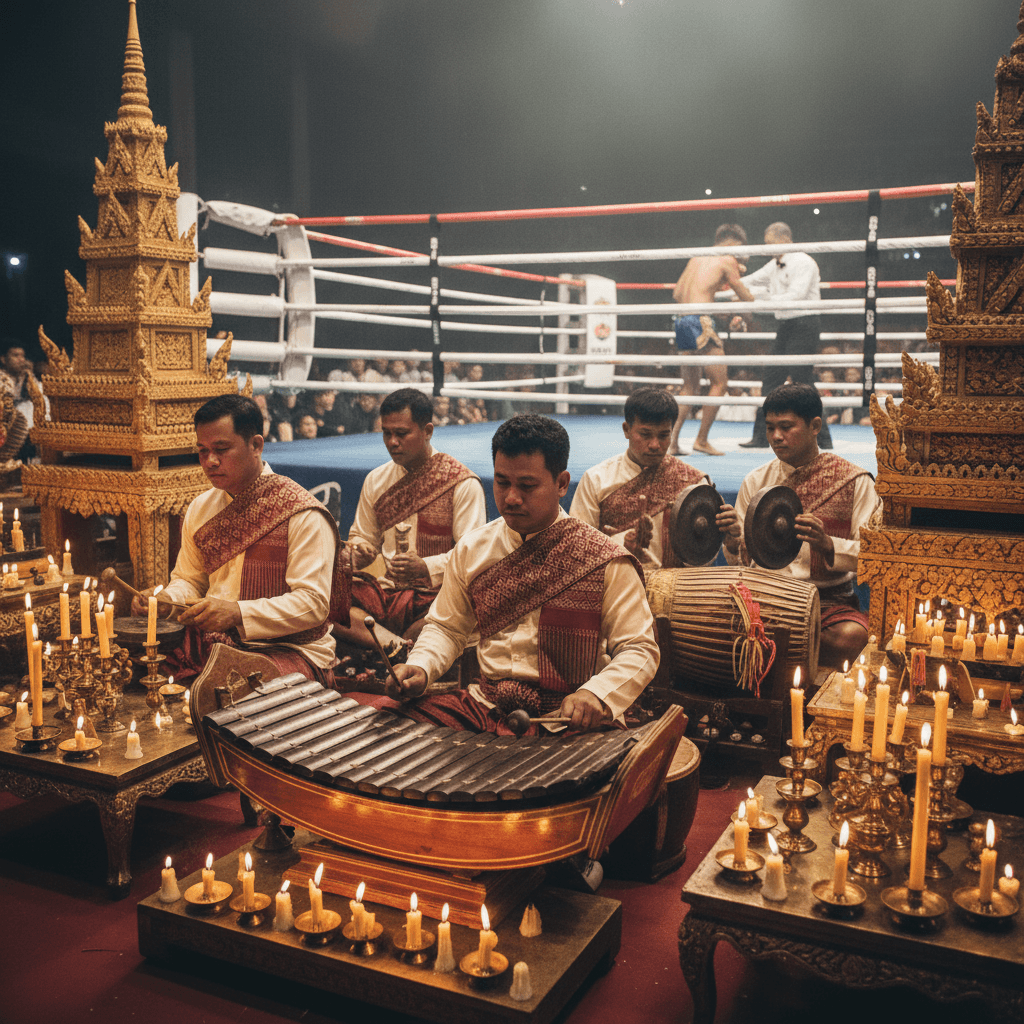
No element of Kun Khmer distinguishes it more immediately from other combat sports than the live musical accompaniment that drives every bout. While Western boxing is fought to crowd noise and arena speakers, and even Muay Thai's Sarama music has become familiar to international audiences, the Pinpeat (ពិណពាទ្យ) orchestra that accompanies Kun Khmer creates a sonic atmosphere that is entirely unique — ancient, hypnotic, and viscerally connected to the action in the ring.
The Pinpeat is not background music. It is an active participant in the fight. The musicians watch the action and adjust their playing in real time, increasing tempo as the exchanges intensify, pulling back during lulls, and exploding into frantic rhythmic patterns during knockdowns and dramatic moments. The fighters, in turn, respond to the music — experienced Nak Muay Khmer use the Pinpeat's rhythm to time their attacks, draw energy from its intensity during difficult moments, and synchronize their movement with the ensemble's pulse.
This symbiotic relationship between fighters and musicians creates a feedback loop that is one of the most remarkable aspects of a live Kun Khmer event. The music drives the fighters, the fighters' actions drive the music, and both together drive the crowd into states of excitement that purely silent or recorded-music combat sports cannot replicate. Attending a Kun Khmer bout with live Pinpeat accompaniment is a fundamentally different experience from watching a recording — the physical presence of the music, felt in the chest as much as heard in the ears, transforms the event from a sporting contest into something closer to a ritual.
The Pinpeat Ensemble
The Pinpeat orchestra used for Kun Khmer is a specific configuration of the broader Pinpeat tradition, which is one of the oldest continuously performed musical traditions in Southeast Asia. The Pinpeat has been the ceremonial and court orchestra of the Khmer people for over a thousand years, accompanying royal ceremonies, temple rituals, classical dance performances, and shadow puppet theater. Its use in Kun Khmer reflects the art's deep roots in Khmer ceremonial culture.
The fight-specific Pinpeat typically consists of five to seven instruments, each serving a distinct musical function. While larger Pinpeat ensembles used in other ceremonial contexts may include additional instruments, the fighting ensemble is optimized for the specific requirements of accompanying combat: clarity of rhythm, dynamic range from quiet to extremely loud, the ability to change tempo rapidly, and sustained endurance over the course of an entire fight card that may last several hours.
ធ្វើបច្ចុប្បន្នភាពចុងក្រោយ: May 2026
The Instruments
Sralai
ស្រឡៃMelodic Lead
A quadruple-reed oboe that produces the piercing, haunting melody that is the most recognizable sound of a Kun Khmer event. The Sralai's continuous, sinuous tone — produced through circular breathing technique — provides the melodic framework over which the entire ensemble operates. Its sound is simultaneously mournful and energizing, creating an atmosphere that heightens the emotional intensity of the fight. The Sralai player must possess exceptional breath control and endurance, as the instrument is played continuously throughout both the Wai Kru ceremony and the fight itself, sometimes for hours without significant pause.
Sampho
សម្ផោRhythmic Leader
A small double-headed barrel drum that serves as the rhythmic heartbeat and de facto conductor of the Pinpeat ensemble. The Sampho player is the most important musician in the context of a Kun Khmer bout because they control the tempo and energy of the music in real time, responding to the action in the ring. The Sampho is played with the hands (no sticks), allowing for an extraordinary range of tonal variation — from soft, steady rhythms during feeling-out exchanges to explosive, rapid-fire patterns during knockdown sequences. The Sampho player watches the fight constantly, reading the fighters' body language, anticipating action, and driving the music accordingly.
Roneat
រនាតMelodic Support
A traditional Cambodian xylophone made of bamboo or hardwood bars suspended over a boat-shaped resonating body. The Roneat provides harmonic support to the Sralai's melody, adding rhythmic melodic patterns that fill out the ensemble's sound. Two types may be present: the Roneat Ek (higher-pitched, more prominent) and the Roneat Thung (lower-pitched, providing bass melodic lines). The bright, percussive tone of the Roneat adds clarity and definition to the musical texture, cutting through the arena noise to maintain the musical structure even during the loudest crowd reactions.
Kong Thom & Kong Tauch
គងធំ និង គងតូចHarmonic Foundation
Semicircular frames holding sets of tuned bronze gongs — the Kong Thom (large gong circle, lower pitch) and Kong Tauch (small gong circle, higher pitch). These instruments provide the harmonic foundation of the ensemble, sustaining chords and tonal centers that anchor the Sralai's melody and the Roneat's patterns. The resonant, shimmering quality of the gongs creates a wash of sound that gives the Pinpeat its characteristic richness and ceremonial gravity. During the Wai Kru, the gongs are particularly prominent, their sustained tones creating an atmosphere of solemnity and spiritual weight.
Skor Thom
ស្គរធំBass Rhythm
Large bass drums played with padded mallets that provide the deep, resonant foundation of the ensemble's rhythm section. The booming, chest-shaking pulse of the Skor Thom is felt as much as heard, particularly in enclosed arena settings. The drums emphasize key rhythmic accents, mark structural points in the music, and add dramatic weight to climactic moments. During knockdowns or dramatic exchanges, the Skor Thom player may add rapid rolls or powerful single strikes that amplify the impact of the action and drive the crowd's emotional response.
The Sampho Drummer: Conductor of Combat
Among all the Pinpeat musicians, the Sampho drummer holds the position of greatest importance and responsibility in the context of a Kun Khmer event. The Sampho player is not merely a musician — they are the conductor of the entire ensemble and, in a real sense, a participant in the fight itself. Their decisions about tempo, intensity, and rhythm directly influence the energy of the bout, the behavior of the fighters, and the emotional state of the crowd.
An experienced Sampho player reads the fight with the eyes of a coach. They watch the fighters' footwork, breathing, body language, and positioning to anticipate what will happen next. When a fighter loads up for a power combination, the Sampho player accelerates the rhythm to match the explosive energy. When fighters clinch and jockey for position, the rhythm shifts to a more insistent, driving pattern that encourages action. When a fighter is hurt and staggering, the Sampho erupts into a frenetic tempo that signals urgency to both the crowd and the healthy fighter.
The skill required for fight Sampho playing is distinct from that required for other Pinpeat contexts. A musician who is excellent at accompanying classical dance or temple ceremonies may struggle with the demands of a fight, which requires the ability to change tempo instantaneously, to sustain extreme intensity for extended periods, and to read and respond to unpredictable physical action in real time. The best fight Sampho players develop an almost telepathic connection with the fighters, creating musical accompaniment that feels not just responsive but predictive — the rhythm shifting an instant before the action intensifies, as if the music is leading rather than following.
The Sampho player also serves a practical function that is sometimes overlooked: they help regulate the pace of the fight. When officials or promoters want to encourage more action — perhaps because a round has been slow — the Sampho player can increase the tempo and intensity of the music, creating social and psychological pressure on the fighters to engage. Conversely, during breaks between rounds, the Sampho player reduces the tempo to allow fighters to recover and corners to work. This regulatory function makes the Sampho player a quasi-official figure in the conduct of the bout, a role that has no equivalent in other combat sports.
How Music Tracks Fight Intensity
The relationship between the Pinpeat music and the fight's intensity follows patterns that are understood by all experienced participants and audience members. While the musicians retain significant creative freedom, the general musical trajectory of a Kun Khmer bout follows recognizable phases.
Pre-fight / Wai Kru phase: The music during the Wai Kru ceremony is distinctly different from the fight music. The tempo is moderate and steady, the melodic lines are more elaborate and contemplative, and the overall mood is ceremonial rather than combative. The Sralai carries the melody prominently, its sustained, weaving tone creating the haunting atmosphere that characterizes the pre-fight ritual. The Sampho provides a steady pulse without the sharp accents that will characterize the fight music. The gongs are more prominent, their resonant tones adding spiritual weight to the proceedings.
Round opening phase: As each round begins, the music transitions from the ceremonial mode to the fight mode. The tempo increases modestly, the Sampho begins adding sharper accents, and the overall energy lifts. During the early feeling-out period of a round, when fighters are measuring distance and looking for openings, the music maintains a moderate, expectant intensity — clearly energized but not yet at peak levels. This musical restraint matches the tactical restraint of the fighters, who are typically probing rather than committing to heavy exchanges in the opening moments.
Mid-round escalation: As the round develops and exchanges become more frequent and committed, the music escalates correspondingly. The Sampho tempo increases noticeably, the Sralai's melody becomes more rapid and insistent, and the overall volume of the ensemble rises. This escalation is not gradual — it tends to occur in steps, triggered by specific moments of action. A clean kick that lands flush, a sharp elbow exchange, or the initiation of an aggressive combination can trigger a sudden jump in musical intensity that amplifies the moment's impact for the audience.
Clinch phases: When fighters enter the clinch, the music takes on a particular character — insistent, driving, and rhythmically dense. The Sampho plays rapid, repetitive patterns that create a sense of urgency and forward momentum, encouraging the fighters to stay active in the clinch rather than simply holding. The tempo during extended clinch sequences is often among the fastest of the fight, reflecting the high-energy, technique-dense nature of Kun Khmer clinch work.
Knockdown or dramatic exchange: When a knockdown occurs or a fighter is visibly hurt, the music explodes into its most intense mode. The Sampho reaches peak tempo, the Skor Thom adds powerful accents, and the entire ensemble plays at maximum volume and energy. This musical explosion serves multiple functions: it signals the dramatic significance of the moment to the audience, it energizes the attacking fighter to press their advantage, and it creates an overwhelming sensory environment that magnifies the spectacle. The sound of the Pinpeat at full intensity during a knockdown sequence is one of the most viscerally exciting experiences in combat sports.
Between rounds: During the rest period between rounds, the music subsides to a low, steady background level. The Sampho plays quietly, maintaining the musical presence without adding energy. This reduction in musical intensity gives fighters, corners, and the audience a brief respite, allowing the emotional arc of the event to breathe before building again.
Pinpeat vs. Thai Sarama
The comparison between Khmer Pinpeat and Thai Sarama (Pi Phat) music is inevitable given the shared heritage and obvious similarities between the two traditions. Both use oboe-type reed instruments, drums, and tuned percussion to accompany fights. Both adjust intensity in response to the action. Both serve ceremonial functions during the pre-fight ritual. However, the differences are significant and contribute meaningfully to the distinct identities of Kun Khmer and Muay Thai.
Instrumental differences: While the instrument families are similar, the specific instruments and their construction differ. The Khmer Sralai and Thai Pi (oboe) produce distinctly different tonal qualities — the Sralai tends toward a more rounded, resonant tone compared to the sharper, more nasal quality of the Thai Pi. The Roneat and Thai Ranat (xylophones) differ in construction and tuning. These instrumental differences create overall sonic textures that are immediately distinguishable to experienced listeners, even without seeing the musicians.
Musical modes and scales: Khmer and Thai classical music use different modal systems, and this fundamental difference in musical DNA gives the fight music of each tradition its characteristic mood. Khmer Pinpeat music often carries a quality that Western listeners describe as more melancholic or contemplative compared to Thai Sarama, which tends toward a more aggressive, driving quality. These are generalizations — both traditions encompass a range of moods — but the overall emotional coloring of the two musical systems is perceptibly different.
Rhythmic emphasis: The rhythmic patterns of Kun Khmer Pinpeat and Muay Thai Sarama differ in their approach to fight accompaniment. The Khmer tradition tends to allow for more dynamic range and variation within a round, with the Sampho player having greater freedom to shift between quiet, contemplative passages and explosive outbursts. The Thai Sarama tradition is often described as maintaining a more consistently high energy level during rounds, with less dramatic variation between quiet and loud passages.
The Sampho vs. Klong Khaek: The role of the lead drummer differs between the traditions. The Khmer Sampho player is typically understood to have greater directorial authority over the ensemble during a fight, functioning more as a conductor who shapes the musical experience in real time. The relationship between the Thai Klong Khaek player and their ensemble follows somewhat different conventions, though the principle of responsive, fight-driven music is shared.
Historical Role in Khmer Warfare
The use of music in combat is not an invention of the sporting arena. The Pinpeat's role in Kun Khmer descends directly from the ancient Khmer practice of using music on the battlefield — a tradition documented in the bas-reliefs of Angkor and described in Chinese diplomatic accounts of the Khmer Empire.
Khmer armies marched to war accompanied by musical ensembles that included drums, horns, and percussion instruments. The music served practical military functions that mirror, in remarkable ways, the functions of fight music in the modern ring. Drums regulated the pace of march. Changes in musical pattern signaled tactical commands — advance, withdraw, hold position, charge. The intensity of the music was used to motivate soldiers before and during combat, creating a sonic environment that elevated aggression and suppressed fear.
Bas-reliefs at the Bayon temple depict military processions with musicians clearly visible among the ranks of soldiers. These carvings show drummers, horn players, and gong players marching alongside armed warriors, confirming that musical accompaniment was integral to Khmer military operations at the height of the empire's power. The transition from battlefield music to ring music was not a reinvention but an adaptation — the same instruments, the same principles of using sound to drive and modulate combat intensity, applied to a new context.
The spiritual dimension of combat music also has ancient roots. Pre-battle music in Khmer warfare served ritual purposes alongside its practical functions. Musicians played specific patterns believed to invoke the protection of gods and spirits, to weaken the spiritual defenses of the enemy, and to create a sacred sonic space within which the warriors fought under divine favor. These beliefs translate directly into the spiritual functions of modern Pinpeat fight music, where the ceremony-opening passages are understood to create a sanctified space and invoke protection.
Understanding this historical continuum is essential to appreciating why the Pinpeat is considered non-negotiable in authentic Kun Khmer. The music is not an optional enhancement or a cultural decoration. It is a fundamental element of the art, rooted in over a thousand years of tradition that connects the modern ring to the ancient battlefield. When the Sralai sounds and the Sampho begins its rhythm at a Kun Khmer event, the fighters, the musicians, and the audience are participating in a tradition that is as old as the Khmer civilization itself.
The Pinpeat in Modern Kun Khmer
The survival of live Pinpeat music in modern Kun Khmer is not guaranteed and requires active preservation. The economics of live musical performance — paying five to seven skilled musicians for an entire event — place financial pressure on promoters, particularly for smaller provincial events. Recorded music is cheaper, more convenient, and requires no coordination with a separate group of performers. The temptation to replace live Pinpeat with recordings is real, and some smaller events have made this compromise.
However, the Kun Khmer community has largely resisted this trend. The major promotions — those broadcast on Bayon TV, CNC, and other national networks — maintain live Pinpeat as a standard requirement. The federations have expressed strong support for live music as an essential element of authentic competition. And fighters themselves overwhelmingly prefer live accompaniment, reporting that the responsive, dynamic quality of a live ensemble creates an energy and atmosphere that recordings cannot replicate.
The challenge of maintaining the Pinpeat tradition is also a question of musician training. Skilled fight Pinpeat players are a specialized subset of Cambodian traditional musicians, and their numbers are not large. Training a competent fight ensemble requires years of musical education in the classical Pinpeat tradition, followed by specific apprenticeship in the demands of fight accompaniment. Ensuring a steady supply of trained fight musicians is a cultural preservation challenge that parallels the challenge of training new Krus and fighters.
For the international audience discovering Kun Khmer, the Pinpeat is often the first element that signals something different and special about this art. The sound is unfamiliar, ancient, and arresting — it transforms what might otherwise appear to be "just another kickboxing event" into something unmistakably Cambodian, carrying the weight of a thousand years of tradition in every note. The Pinpeat does not just accompany Kun Khmer. It is Kun Khmer.