កាបូបការហ្វឹកហាត់
Bag Work
The heavy bag is where shadow boxing meets reality. It is the first piece of equipment that hits back — with resistance, feedback, and consequences for bad technique. The bag tells you the truth about your striking: whether your punches snap or push, whether your kicks land with the shin or the foot, whether your balance survives impact. This guide covers everything from heavy bag fundamentals to pad holding and specific combinations.
Heavy Bag Technique Guide
Principles for productive heavy bag work
Distance Management
Stand at the correct range for each weapon. Punches land with the knuckles at full arm extension. Round kicks land with the shin at hip-to-rib height. Standing too close turns every strike into an arm punch or a slapping kick. Standing too far forces you to reach and lose balance.
Hit Through the Bag
Do not aim at the surface of the bag — aim six inches through it. This applies to every strike. A jab should penetrate through the bag. A round kick should try to wrap around it. Aiming at the surface creates a pushing force; aiming through it creates a snapping, damaging impact.
Return to Guard
After every strike, your hands must return to your guard position. The bag does not hit back, so your brain will try to skip this step. Do not let it. Make returning to guard as automatic as throwing the strike itself. Every rep without returning to guard is a rep teaching you bad habits.
Move Your Feet
Do not stand in one spot and unload. Throw a combination, step off at an angle, reset, throw another combination. Circle the bag. Close distance, fire, create distance. The bag is your opponent — treat it like one.
Vary Your Rhythm
Beginners fall into a metronomic rhythm: strike-pause-strike-pause. Real fighting has varying tempos: bursts of speed, pauses, single shots, rapid flurries. Practice all rhythms on the bag. Throw three fast strikes, pause, throw one hard shot, move, throw five strikes in rapid succession.
Use All Eight Limbs
The heavy bag is the perfect tool for practicing all Kun Khmer weapons. In each round, throw punches, elbows, knees, and kicks. Practice clinch knees by grabbing the bag. Throw elbows at close range. Mix teeps with round kicks. If you only punch the heavy bag, you are doing Western boxing, not Kun Khmer.
ការកាន់ផែនក
Thai Pad Holding Guide
How to hold pads safely and effectively for your training partner
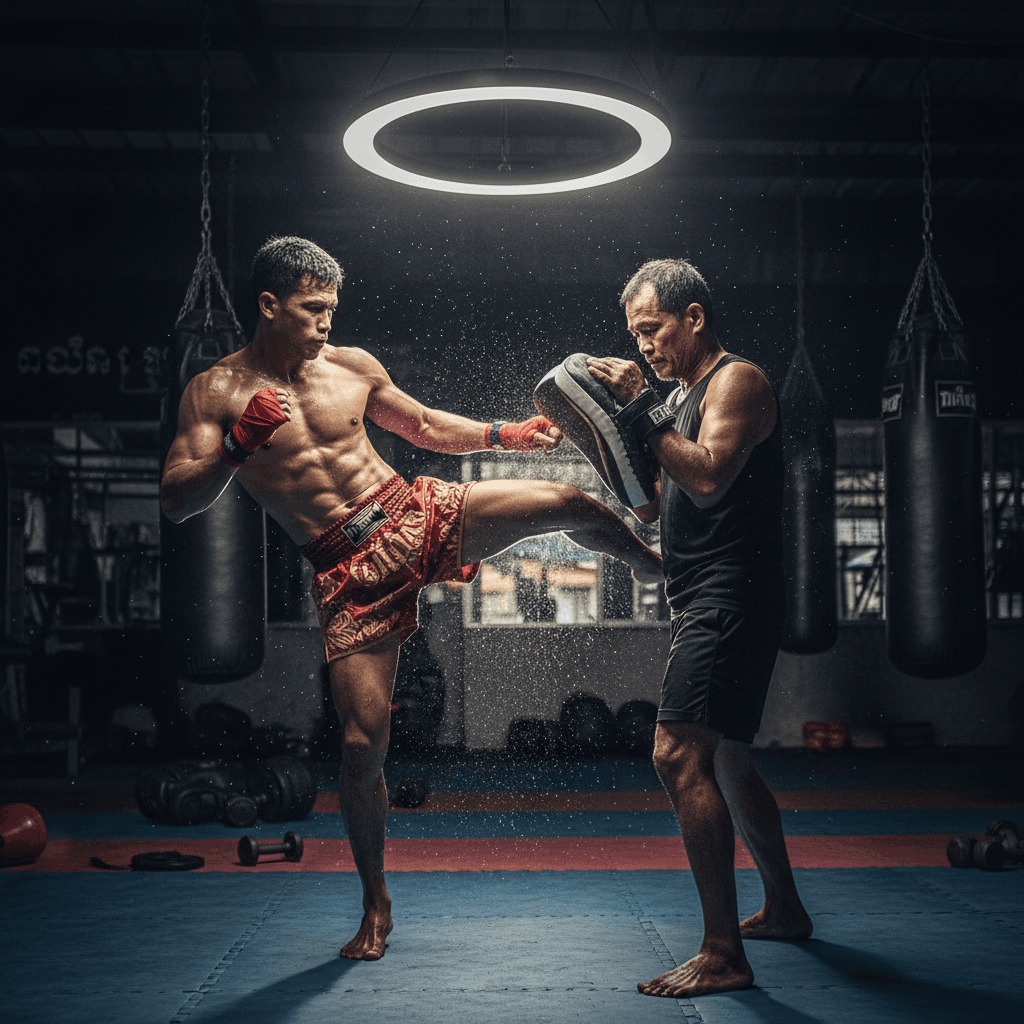
Holding Thai pads is a skill unto itself. A good pad holder does not just absorb strikes — they create a realistic training experience that develops timing, accuracy, and fight intelligence in the striker. If you are serious about Kun Khmer, you must learn to hold pads as well as you learn to hit them.
For Punches
Hold pads at shoulder height, roughly head width apart. Angle the pads slightly inward so punches make solid contact. Meet the punch with a slight push toward the striker — this provides realistic resistance and protects your shoulders. For hooks, turn the pad sideways. For uppercuts, hold the pad flat facing downward at chin height.
For Kicks
For round kicks, hold the pad against your forearm at the appropriate height (leg, body, or head). Brace your core and lean slightly into the kick. Do not pull the pad away on impact — this robs the striker of feedback. For the teep, hold the pad in front of your belly with both hands and absorb the push backward.
For Elbows and Knees
Hold the pad tight against your body for elbow strikes. For horizontal elbows, hold the pad at temple height against the side of your head (behind the pad). For knees, use a belly pad if available, or hold Thai pads low against your midsection. Brace your core firmly for knee impacts.
Calling Combinations
A great pad holder calls combinations verbally and with pad position. Show the target, call the strike, and adjust for the next one in the sequence. Vary the rhythm — do not fall into a predictable pattern. Occasionally throw a light strike back at the pad worker to keep their defense honest. This is what separates pad holding from target holding.
Focus Mitt Work
Precision striking for hand speed and accuracy
Focus mitts (small hand pads) are primarily used for punching combinations and hand speed development. They demand greater accuracy than Thai pads and allow the holder to simulate an opponent's head movement. In Kun Khmer, focus mitts are used to sharpen the boxing game that sets up the more devastating weapons.
Speed Rounds
Holder shows mitts in rapid sequence. Striker must hit each target the instant it appears. Develops reaction time and hand speed. Start with simple jab-cross patterns and progress to complex combinations with head movement and body shots. Three-minute rounds with 30-second rest.
Accuracy Rounds
Holder presents small targets at varying heights and angles. Striker must hit the center of each mitt cleanly. Misses are called out. This develops the pinpoint accuracy needed to land clean scoring shots through an opponent's guard. Speed is secondary — clean contact is the goal.
Defense Integration
The holder periodically swipes a mitt at the striker's head (simulating a hook) or pushes a mitt at the body (simulating a jab). The striker must slip, parry, or block, then immediately counter on the next presented target. This builds the offense-defense flow critical in competition.
បន្សំទាំង១០
10 Bag Combinations
Specific combinations to drill on the heavy bag and pads
The Bread and Butter
Jab - Cross - Lead Hook - Rear Round Kick
The most fundamental combination in Kun Khmer. The three punches set up the power kick. Rotate your hips fully on the kick.
The Teep Setup
Jab - Jab - Rear Teep - Cross - Lead Hook
Double jab to measure distance, teep to push the bag/opponent back, then close with punches. The teep creates a reset moment.
The Elbow Entry
Jab - Cross - Step In - Lead Horizontal Elbow - Rear Uppercut Elbow
Punches close the distance, then step inside for elbow range. The horizontal elbow targets the temple; the uppercut elbow targets the chin.
The Knee Barrage
Jab - Cross - Clinch the Bag - Straight Knee (R) - Straight Knee (L) - Straight Knee (R) - Push Away - Rear Round Kick
Enter the clinch off punches, deliver three alternating knees, push away, and finish with a kick as the bag swings back.
The Low-High
Rear Low Kick - Lead Hook - Cross - Lead Round Kick (Head)
Attack low to drop the guard, then go high. The low kick forces the opponent to look down; the head kick catches them looking.
The Counter-Puncher
Slip Right - Lead Hook (Body) - Cross - Lead Hook (Head) - Rear Round Kick
Simulate slipping a jab, then counter with a body-head combination. The body shot brings the guard down; the head shots exploit the opening.
The Body Destroyer
Jab - Lead Hook (Body) - Cross - Rear Knee (Body) - Lead Elbow
Every strike targets the midsection except the finishing elbow. Systematic body attack breaks down even the toughest opponents over time.
The Switch Kick Special
Jab - Cross - Switch Kick (Lead Leg Round Kick) - Rear Cross - Lead Hook
The switch kick changes your angle and catches opponents expecting a rear kick. Follow with punches while they are still processing the angle change.
The Clinch Exit
Clinch the Bag - Knee (R) - Knee (L) - Push Away - Rear Horizontal Elbow - Cross
Practice the critical transition from clinch to striking range. The push creates space for the elbow, which creates space for the cross.
The Finishing Sequence
Jab - Cross - Lead Hook - Cross - Lead Uppercut - Rear Elbow - Lead Knee - Rear Round Kick
An eight-strike combination using all weapons. This is the fight-finishing sequence — thrown when your opponent is hurt and you need to pour it on. Practice until it flows as one continuous motion.
6-Round Bag Session Structure
A structured bag session from warm-up to burnout
Warm-Up Round
Light single strikes and doubles. Find your distance. Establish your rhythm. Jabs, teeps, and light round kicks only. Move around the bag.
Combination Round
Throw 3-4 strike combinations from the list above. Focus on technique and flow between strikes. Every combination ends with a defensive movement.
Power Round
Sit down on your strikes. Each combination should have maximum power on the finishing strike. Cross, round kick, and elbow are your power shots. Set them up with speed strikes.
All Weapons Round
Must use all eight limbs in this round. Every 30 seconds, switch your primary weapon: 30 seconds punches, 30 seconds elbows, 30 seconds knees, 30 seconds kicks, then combine everything.
Clinch Round
Grab the bag. Deliver knee barrages. Push away, elbow on the break. Pull the bag in, throw knees. Push it away, kick as it swings back. This round simulates clinch fighting.
Burnout Round
Maximum output for the entire round. Non-stop combinations at fight pace. When fatigue hits, push through it. This round builds the mental toughness and anaerobic capacity needed for the championship rounds.
Each round is 3 minutes with 1 minute rest between rounds. Total session time: 23 minutes. Add a 5-minute warm-up before and 5-minute cool-down after for a complete 33-minute bag workout.