Ancient Origins: The Roots of Khmer Combat
The origins of Kun Khmer are deeply intertwined with the earliest history of the Khmer people themselves. Long before the grandeur of Angkor, the communities that would become the Khmer civilization developed fighting systems born from the practical necessities of survival in Southeast Asia. Archaeological evidence from the Funan and Chenla kingdoms — the precursors to the Khmer Empire — suggests that organized combat training was already a component of warrior preparation as early as the second century BCE.
These early fighting methods were not sport. They were battlefield systems designed for the close-quarters combat that characterized warfare in the dense jungles and river plains of what is now Cambodia, southern Vietnam, and parts of Thailand and Laos. Warriors fought with weapons — swords, spears, and shields — but unarmed combat was an essential secondary skill for when weapons were lost or fighting moved to grappling range. The unarmed techniques that survived and evolved through centuries of warfare would eventually crystallize into the art we now call Kun Khmer.
Indian cultural influence, which began arriving in Southeast Asia through trade routes during the first centuries of the common era, shaped the spiritual and ritualistic framework surrounding Khmer combat. The concepts of dharmic warrior duty, the invocation of divine protection before battle, and the master-student transmission model all bear the imprint of Hindu and Buddhist traditions that merged with indigenous Khmer spiritual practices. This fusion created something unique — a martial art that was simultaneously a physical discipline, a spiritual practice, and an expression of cultural identity.
Early Khmer warriors trained in what are sometimes referred to as Kbach Kun Boran (ancient fighting forms) — codified sequences of movements that preserved combat techniques in a teachable format. These forms, analogous to kata in Japanese martial arts or poomse in Korean systems, encoded strikes, blocks, evasions, and counterattacks into rhythmic patterns that could be practiced solo and transmitted across generations. While the specific forms have evolved considerably over two millennia, the principle of preserving technique through choreographed practice remains central to Kun Khmer training today.
The Angkor Period (802-1431): Empire of Warriors
The founding of the Khmer Empire by Jayavarman II in 802 CE marked the beginning of one of the most remarkable civilizations in human history — and with it, the formalization of Khmer martial arts into a sophisticated, institutionalized system. The Khmer Empire, which at its height controlled vast territories encompassing modern-day Cambodia, Thailand, Laos, and southern Vietnam, maintained its dominance for over six centuries through a combination of engineering genius, religious authority, and overwhelming military power.
Martial training was not optional for males of the warrior class. Young men entered training at dedicated military camps where they learned weapons combat, unarmed fighting, wrestling, and horseback warfare. The unarmed component of this training — the direct ancestor of modern Kun Khmer — emphasized strikes with all eight points of contact: fists, elbows, knees, and feet. The elbow, in particular, was developed as a devastating close-range weapon, a characteristic that distinguishes Kun Khmer from many other striking arts to this day.
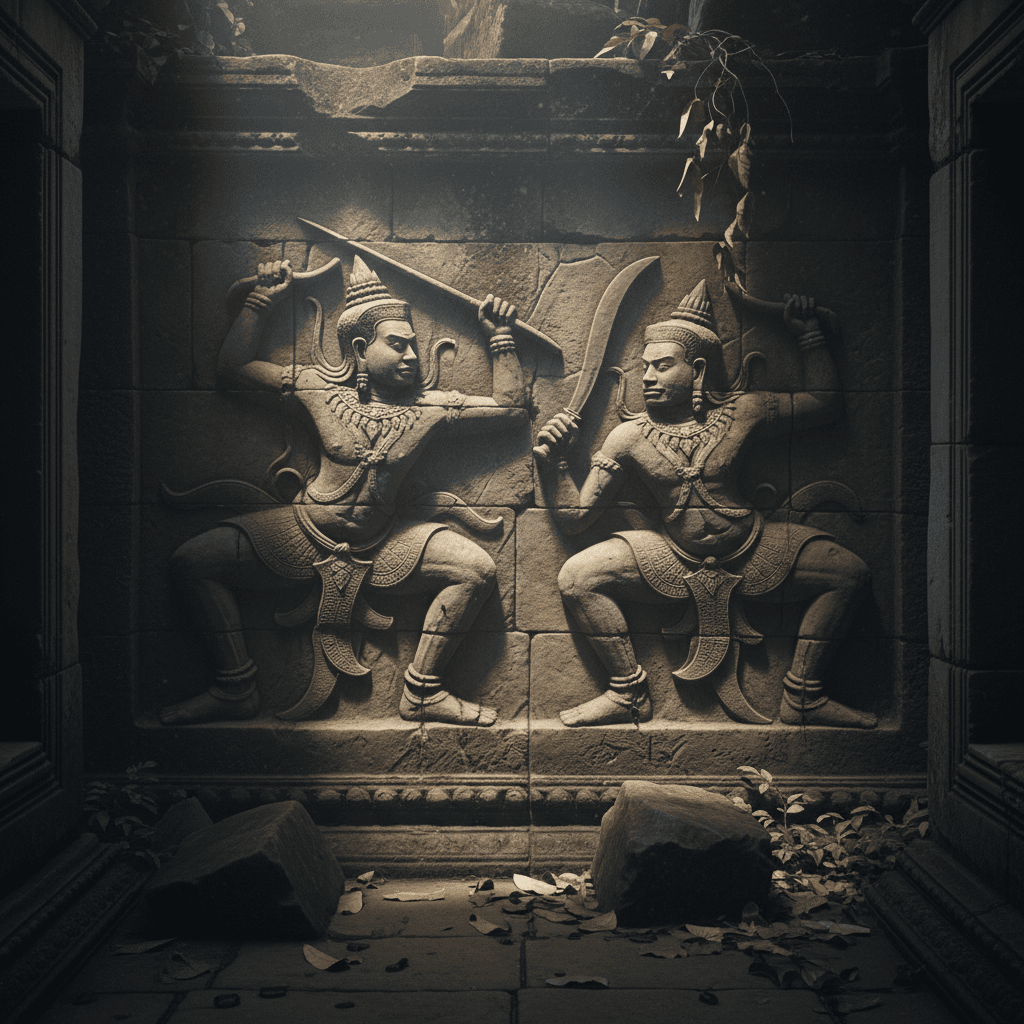
The most compelling physical evidence of Angkor-era fighting techniques survives in the bas-reliefs carved into the walls of the empire's monumental temples. At Angkor Wat, constructed under Suryavarman II between 1113 and 1150 CE, elaborate carvings depict scenes from Hindu epics alongside historical military campaigns. Warriors are shown executing recognizable fighting techniques — knee strikes, elbow attacks, clinch positions, and kicks — providing a visual record of combat methods that are strikingly similar to techniques practiced in Kun Khmer rings today.
The Bayon temple, built under Jayavarman VII in the late twelfth and early thirteenth centuries, contains even more detailed depictions of hand-to-hand combat. Panels show fighters in various stages of engagement: squaring off in fighting stances, exchanging strikes, locked in clinch positions, and executing throws and sweeps. Military historians have noted that the body mechanics depicted in these carvings demonstrate a level of martial sophistication comparable to any fighting system in the medieval world.
Under Jayavarman VII, the empire's greatest builder and arguably its most powerful ruler, the warrior culture of the Khmer reached its zenith. Jayavarman VII's armies conquered the Cham kingdom, repelled Vietnamese incursions, and maintained control over a territory of extraordinary size. Kun Khmer practitioners today trace their lineage directly to these warrior traditions, and the art's emphasis on aggressive forward pressure, devastating clinch work, and finishing power reflects the battlefield mentality of its imperial origins.
Post-Angkor Decline and Preservation (1431-1863)
The fall of Angkor to the Siamese kingdom of Ayutthaya in 1431 was a catastrophic turning point for Khmer civilization. The imperial capital was sacked, the court dispersed, and the centralized institutions that had supported and codified martial training were destroyed. In the centuries that followed, Cambodia entered a prolonged period of decline, squeezed between the expansionist ambitions of Siam to the west and Vietnam to the east, losing territory and political autonomy in a long, painful contraction.
Yet the martial arts did not die. They survived in the villages, passed from master to student in rural communities far from the ruined capital. Kun Khmer became a folk art, maintained by local kru (masters) who preserved techniques, rituals, and training methods through oral tradition and direct physical instruction. Without the institutional support of the empire, the art became more decentralized and regionally diverse, with different provinces developing distinctive stylistic emphases while maintaining the core technical vocabulary.
During this period, the relationship between Khmer and Siamese martial arts became deeply contested — a controversy that persists to the present day. The Siamese capture of Angkor included the taking of Khmer court dancers, musicians, scholars, and almost certainly martial artists. Thai historians acknowledge that the cultural exchange between the two kingdoms was extensive, and many elements of what became Muay Boran bear strong similarities to Khmer techniques depicted in Angkorian bas-reliefs. Cambodians argue, with considerable historical justification, that the Thai art absorbed significant Khmer influence during this period of conquest and cultural appropriation.
Village-level Kun Khmer during the post-Angkor centuries was closely integrated with religious and agricultural cycles. Bouts were held during festivals, temple celebrations, and harvest events. The Wai Kru ritual — the pre-fight ceremony paying respect to teachers and spiritual protectors — solidified during this period as a defining feature of Khmer boxing, carrying forward the Hindu-Buddhist spiritual framework of the imperial era into the folk practice of rural Cambodia.
The Colonial Period (1863-1953)
The establishment of the French Protectorate over Cambodia in 1863 brought yet another disruption to the trajectory of Kun Khmer. French colonial administrators generally viewed indigenous martial traditions with a mixture of condescension and suspicion. Traditional fighting was seen as primitive and potentially dangerous to colonial order. While the French did not explicitly ban Kun Khmer in the way they suppressed political organizing, the overall colonial project of cultural assimilation and modernization marginalized traditional Cambodian practices, including martial arts.
However, the colonial period also, paradoxically, planted the seeds for the modernization of Kun Khmer as a competitive sport. In the 1920s and 1930s, colonial administrators began organizing public boxing events, partly as entertainment and partly as a controlled outlet for martial energy. These events introduced concepts borrowed from Western boxing: timed rounds, scoring by judges, designated fighting areas, and weight classifications. The fusion of traditional Khmer fighting technique with Western sporting structure created the basic framework of competitive Kun Khmer as it exists today.
French-era Cambodia also saw the first use of boxing gloves in Kun Khmer competition. Traditional bare-knuckle fighting, sometimes with rope-wrapped hands, gave way to gloved competition. This change, while reducing certain types of injury, also altered the technical emphasis of the art. Throughout the colonial period, the Wai Kru ceremony and Pinpeat music remained non-negotiable elements of Kun Khmer presentation, surviving colonialism largely intact — a testament to their deep significance in Cambodian cultural identity.
The Golden Era: Mid-20th Century Revival (1953-1970)
Cambodia's independence in 1953 under King Norodom Sihanouk ushered in a period of intense national pride and cultural revival. Kun Khmer benefited enormously from this atmosphere. Sihanouk, who was keenly aware of the role that cultural identity played in nation-building, supported the promotion of traditional Cambodian arts, including martial arts. Government-backed events, media coverage, and the construction of dedicated fighting stadiums transformed Kun Khmer from a rural folk practice into a national sport with a growing urban audience.
The 1960s represent the undisputed golden age of Cambodian boxing. Phnom Penh's stadiums — particularly the Olympic Stadium built for the 1963 Southeast Asian Peninsular Games — hosted regular bouts that drew enormous crowds. The atmosphere at these events was electric: the Pinpeat orchestra driving the rhythm, gamblers shouting odds, entire families filling the stands for hours of competition. Fighters became national celebrities, their names known across the country.
This era produced legendary fighters whose names are still revered in Cambodian martial arts culture. Fighters like Pich Arun, known as the Lion of Battambang, demonstrated a level of technical sophistication and competitive intensity that set standards still referenced today. The krus of this period refined training methodologies, developing systematic approaches to conditioning, technique development, and fight strategy that drew on traditional knowledge while incorporating modern understanding of physical preparation.
International competition also expanded during this period. Cambodian fighters competed against Thai, Lao, and Vietnamese opponents in cross-border events that were as much about national prestige as sporting achievement. These bouts — particularly those against Thai fighters — carried intense emotional significance for Cambodian audiences, given the centuries of historical rivalry between the two nations.
The Khmer Rouge Devastation (1975-1979)
On April 17, 1975, the Khmer Rouge marched into Phnom Penh and began one of the most horrific episodes of genocide in human history. Over the next three years, eight months, and twenty days, the regime of Pol Pot systematically murdered approximately two million Cambodians — roughly a quarter of the entire population. The devastation inflicted on Kun Khmer and Cambodia's martial arts culture during this period cannot be overstated.
The Khmer Rouge's ideology targeted anyone associated with pre-revolutionary culture, education, or tradition. Krus — martial arts masters — were classified as part of the old society that had to be destroyed. Many were executed outright. Others perished in the forced labor camps, from starvation, disease, or exhaustion. The regime banned all traditional cultural practices, including the Wai Kru ceremony, the Pinpeat music, and competitive fighting of any kind. Stadiums fell silent. Training ceased. An unbroken chain of master-to-student transmission stretching back centuries was violently severed.
The scale of loss is staggering. It is estimated that the majority of Cambodia's active Kun Khmer masters perished during the Khmer Rouge period. With them died an incalculable amount of technical knowledge, training methodology, and cultural understanding that had been transmitted orally for generations. Techniques that had been refined over centuries, tactical insights passed from master to student, the subtle body mechanics that can only be communicated through physical demonstration — vast stores of martial knowledge simply ceased to exist.
Some practitioners survived by hiding their skills, by luck, by being in rural areas already under Khmer Rouge control before the worst purges, or by fleeing the country. These survivors — scattered, traumatized, many having lost their families and communities — would become the fragile links through which Kun Khmer would eventually be rebuilt.
Reconstruction: Rising from the Ashes (1979-2000)
The Vietnamese overthrow of the Khmer Rouge in January 1979 ended the genocide but left Cambodia in ruins. The country that emerged from the killing fields was shattered — its infrastructure destroyed, its population traumatized, its cultural institutions obliterated. The reconstruction of Kun Khmer began in this context of overwhelming devastation and scarcity.
In the 1980s, surviving krus began cautiously to teach again. In Phnom Penh and in provincial towns, small training groups formed around the handful of masters who had survived. These men — many of them elderly, many bearing the physical and psychological scars of the genocide — took on the enormous responsibility of rebuilding an entire martial tradition from what they could remember. The process was painstaking and incomplete.
Competitive Kun Khmer gradually returned during the late 1980s and 1990s. Events were initially small, informal affairs — a ring set up in a market square, a few bouts between local fighters, a modest Pinpeat ensemble providing music. But the hunger for the art was enormous. Cambodians who had grown up during the Khmer Rouge era had been denied their martial heritage, and the return of Kun Khmer carried profound emotional significance beyond sport.
Television played a transformative role in the revival. As Cambodian media infrastructure developed in the 1990s, televised Kun Khmer bouts reached audiences across the country. Weekly fight shows became appointment viewing, creating a new generation of fans and inspiring young Cambodians to seek out training. The 1990s also saw the first significant Kun Khmer activity in the Cambodian diaspora.
The Modern Era: Recognition and Growth (2000-Present)
The twenty-first century has witnessed the most sustained period of growth for Kun Khmer since the golden era of the 1960s. The establishment of the Kun Khmer Federation in 2008 provided institutional structure for the sport, standardizing rules, organizing rankings, and representing Cambodian boxing in international forums. The federation has worked to distinguish Kun Khmer as a distinct martial art and sport, separate from Muay Thai, with its own identity, traditions, and competitive framework.
Major promotions now host regular events at venues including the TV5 Studio, CNC Arena, and provincial stadiums across Cambodia. Prize money, while still modest by global combat sports standards, has increased significantly, and top fighters can now sustain professional careers. International events have brought Kun Khmer fighters into competition with Muay Thai practitioners, kickboxers, and other striking specialists, with Cambodian fighters consistently demonstrating the effectiveness of their art against diverse opponents.
The question of cultural ownership and historical precedence — particularly in relation to Muay Thai — has intensified in the modern era. Cambodian martial arts advocates point to the Angkorian bas-reliefs as evidence that organized striking arts existed in the Khmer Empire centuries before the Thai kingdoms adopted similar practices.
Digital technology has opened new frontiers for preservation and promotion. Online platforms host Kun Khmer technique tutorials, fight archives, and cultural documentation that would have been impossible a generation ago. Social media has connected practitioners across borders, created new audiences, and given Cambodian fighters international visibility that traditional media channels could never provide.
The Kun Khmer vs. Muay Thai Debate
No history of Kun Khmer would be complete without addressing the ongoing debate over its relationship to Muay Thai. This is not merely an academic question — it touches on deep issues of national identity, cultural ownership, and historical justice that resonate powerfully in both Cambodia and Thailand.
The Cambodian position, supported by considerable archaeological and historical evidence, holds that the Khmer Empire possessed sophisticated martial arts centuries before the Thai kingdoms rose to prominence. The bas-reliefs at Angkor Wat and Bayon, dating from the twelfth and thirteenth centuries, depict fighting techniques that are recognizably ancestral to modern Kun Khmer. When Ayutthaya conquered Angkor in 1431, the Siamese kingdom absorbed extensive Khmer cultural knowledge, including, Cambodians argue, martial arts traditions that influenced the development of what would become Muay Thai.
The technical similarities between the two arts are undeniable. Both use the full eight-limb striking system. Both incorporate clinch work, sweeps, and the ritual pre-fight ceremony. Both are fought to traditional music. However, meaningful differences exist: Kun Khmer places greater emphasis on elbow techniques and tends toward a more aggressive, forward-pressing style.
Modern practitioners on both sides increasingly recognize that the debate, while historically important, should not overshadow the shared heritage and mutual respect between two great martial traditions. Kun Khmer does not need to diminish Muay Thai to establish its own legitimacy, and its case for historical primacy rests on evidence that speaks for itself.
The Living Art: Looking Forward
Kun Khmer enters the third decade of the twenty-first century in a position of cautious optimism. The art has survived conquest, colonialism, and genocide. It has been rebuilt, against extraordinary odds, by dedicated practitioners who refused to let it die. International recognition is growing, competitive standards are rising, and digital technology is enabling preservation and promotion at a scale previously impossible.
Yet challenges remain. The commercial gap between Kun Khmer and Muay Thai remains vast. Fighter pay, while improving, is still insufficient to attract the full depth of Cambodian athletic talent. The knowledge lost during the Khmer Rouge period can never be fully recovered, and the urgency of documenting the memories of surviving golden-era practitioners grows with each passing year.
The Kun Khmer Bible exists to serve this moment — to document, preserve, and share the knowledge of Cambodia's martial heritage in the most comprehensive and accessible form possible. Every technique breakdown, every historical chapter, every training program on this site is an act of preservation.
The story of Kun Khmer is, ultimately, the story of Cambodia itself — resilient, proud, scarred but unbroken, and determined to carry its heritage forward into the future.