The Historical Relationship
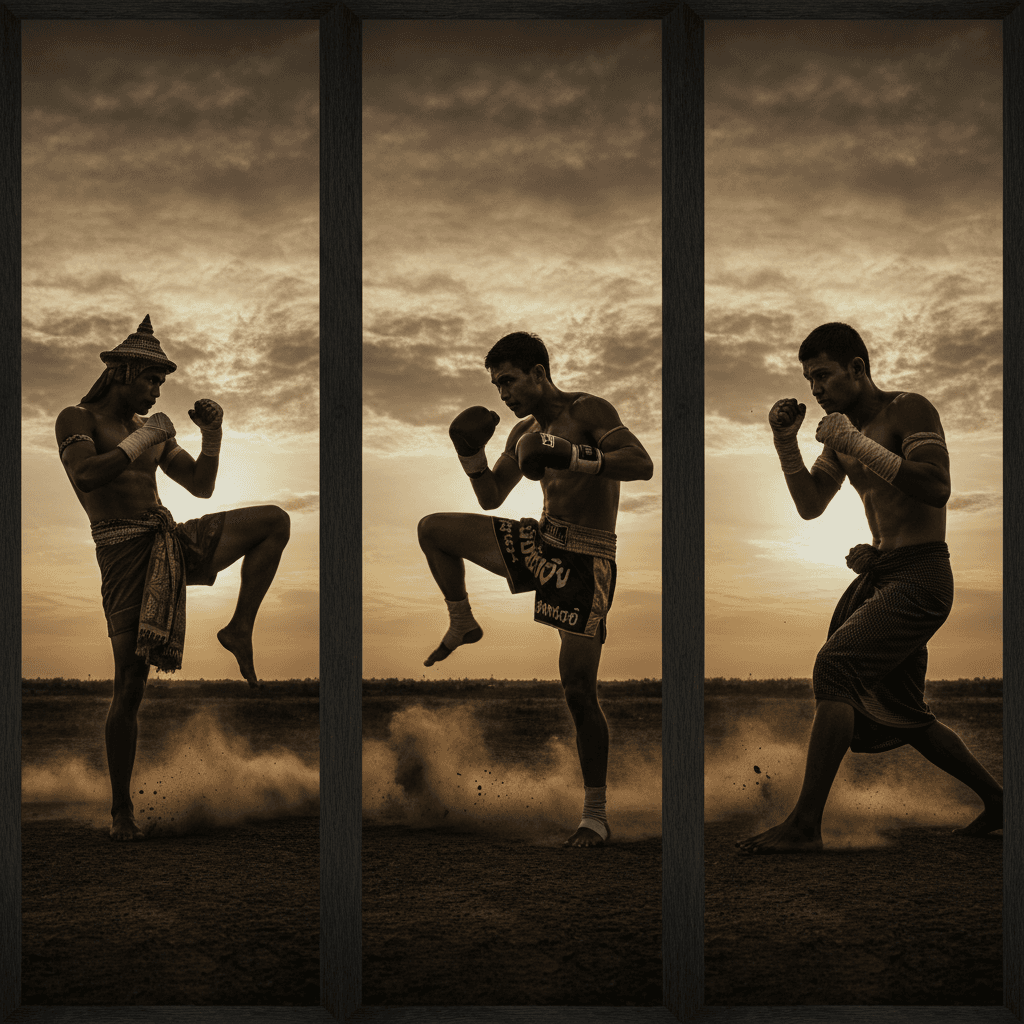
Kun Khmer, Muay Thai, and Lethwei are not independent inventions that coincidentally resemble each other. They are branches of a shared martial heritage that developed across mainland Southeast Asia over more than a millennium, shaped by the same geographical, cultural, and military forces. Understanding their relationship requires acknowledging both the common roots and the distinct evolutionary paths that produced three recognizably different — yet clearly related — fighting arts.
The region that now encompasses Cambodia, Thailand, Myanmar, Laos, and Vietnam was historically a zone of intense cultural exchange, military conflict, and population movement. Empires rose and fell, borders shifted, populations migrated, and martial knowledge traveled with them. The Khmer Empire (802-1431 CE) dominated the region for centuries and exerted profound cultural influence over neighboring peoples, including the Thai kingdoms that eventually conquered Angkor. The Pagan Empire in Burma (849-1297 CE) developed its own martial traditions in parallel, influenced by Indian cultural models similar to those that shaped Khmer practice.
The concept of fighting with "eight limbs" — fists, elbows, knees, and kicks — is common to all three traditions and represents a shared Southeast Asian martial philosophy that distinguishes the region's arts from the predominantly hand-focused boxing of the West, the kick-focused arts of Korea, or the grappling emphasis of Japanese martial traditions. This shared framework suggests either a common origin or extensive cross-pollination, or most likely both.
The Origin Debate
The question of which art came first — and who influenced whom — is one of the most contentious topics in martial arts history. It is also one of the most important to address honestly, because it touches on issues of national identity and cultural pride that resonate deeply in all three countries.
The Cambodian case rests primarily on archaeological evidence. The bas-reliefs at Angkor Wat (built 1113-1150 CE) and the Bayon temple (late 12th century) depict warriors in fighting stances, executing techniques, and engaged in combat that is recognizably ancestral to modern Kun Khmer. These carvings predate the earliest documented Thai martial arts references by several centuries. When the Siamese kingdom of Ayutthaya conquered Angkor in 1431, they took Khmer court dancers, scholars, artisans, and — Cambodians argue — martial knowledge. The subsequent development of Muay Thai, in this view, was significantly influenced by absorbed Khmer martial traditions.
The Thai case emphasizes the independent development of Muay Thai within Thai warrior culture. Thai historians point to their own martial traditions predating contact with Angkor, to the distinct stylistic developments within Thai boxing that do not map neatly onto Khmer techniques, and to the reality that cultural exchange in the region was mutual rather than unidirectional. The Thais borrowed from the Khmer, certainly — but the Khmer also borrowed from the Thais, and both borrowed from Indian, Chinese, and other regional cultures.
The Burmese case is somewhat separate, as Lethwei's development in the western part of the mainland was more insulated from the Khmer-Thai cultural zone, though not entirely disconnected. Lethwei's retention of bare-knuckle fighting and the legality of headbutts distinguish it as the most conservative of the three arts in preserving what may be an older form of Southeast Asian striking combat, before the modernizing influences of colonial-era regulation.
The honest assessment is that all three arts share common ancestral roots in mainland Southeast Asian martial culture, that significant cross-pollination occurred over centuries of contact and conflict, and that each art developed its own distinctive identity through the unique cultural, military, and social conditions of its home country. Attempting to declare a single "winner" of the origin debate oversimplifies a complex historical reality.
Stylistic Differences in Technique
While the three arts share the eight-limb framework (nine for Lethwei with headbutts), meaningful technical differences distinguish them — differences that become apparent even to casual observers when watching bouts from each tradition side by side.
Kun Khmer is characterized by aggressive forward pressure, explosive combination work, and a particular emphasis on elbows as finishing weapons. Cambodian fighters tend to favor a more upright stance that facilitates rapid offensive transitions, moving from punches to elbows to knees with minimal positional adjustment. The clinch in Kun Khmer is an offensive platform rather than a control position — fighters in the clinch are expected to be actively attacking with knees and elbows rather than simply fighting for position. The overall aesthetic of high-level Kun Khmer is violent and direct, with a premium placed on knockdowns and stoppages over technical point accumulation. For how Kun Khmer bouts are actually judged, see the official rules and scoring of Kun Khmer.
Muay Thai emphasizes technical precision, timing, and the aesthetic quality of technique. Thai fighters are renowned for their patience, their ability to control range, and their mastery of the long-range teep (push kick) as both an offensive and defensive tool. The Thai clinch is more developed as a positional control system, with sophisticated techniques for off-balancing opponents and executing sweeps that score highly in Thai scoring systems. Muay Thai's scoring places significant weight on balance, control, and the appearance of dominance, which encourages a more measured, rhythmic fighting style compared to Kun Khmer's emphasis on aggression and finishing.
Lethwei is the most raw and aggressive of the three. The legality of headbutts fundamentally changes the fighting dynamic — clinch range becomes even more dangerous, and the headbutt adds an entirely new dimension to close-range combat. Traditional Lethwei, fought bare-knuckle with only hand wraps, produces a fighting style that prioritizes toughness, durability, and pure aggression over technical sophistication. The bare-knuckle format makes cuts more likely and knockouts more sudden, creating a spectacle that is brutally compelling. Modern Lethwei events that use gloves have brought the sport closer in style to Muay Thai and Kun Khmer, though the headbutt and the cultural emphasis on warrior toughness remain distinctive.
Cultural Differences
Beyond technique, the three arts are embedded in distinct cultural contexts that shape every aspect of their practice, from the pre-fight rituals to the training methodology to the relationship between fighter and community.
Kun Khmer carries the weight of Cambodia's tragic modern history. The near-destruction of the art during the Khmer Rouge period (1975-1979) gives its practice an emotional resonance that extends beyond sport — every Kun Khmer event is, on some level, an act of cultural survival and reclamation. The Pinpeat music, the Wai Kru ceremony, the Mongkol and Prajioud — these elements are not cultural decoration but essential expressions of an identity that was nearly erased. The Cambodian diaspora's role in preserving the art adds another dimension of cultural significance.
Muay Thai benefits from Thailand's position as the only Southeast Asian country never colonized by European powers, and from decades of sophisticated commercial development and international promotion. Muay Thai is a source of uncomplicated national pride, supported by royal patronage, massive commercial infrastructure, and a global network of gyms and practitioners. The Thai approach to their art is confident, well-resourced, and outward-facing — they have successfully positioned Muay Thai as a global sport with Olympic aspirations.
Lethwei reflects Myanmar's complex political and social landscape. The art has endured decades of military rule, economic isolation, and limited international exposure. Lethwei fighters are revered as embodiments of Burmese courage and resilience, and the sport's uncompromising rules — particularly the traditional bare-knuckle format and the win-by-KO-only system — reflect a cultural emphasis on toughness that resonates deeply in Myanmar's martial identity.
Governing Bodies
The organizational structures of the three arts reflect their different levels of commercial development and international reach.
Kun Khmer is governed domestically by the Kun Khmer Boxing Safety Federation (KBSF), which standardizes rules, oversees safety protocols, and manages rankings and championships within Cambodia. Internationally, Kun Khmer falls under the broader umbrella of the International Federation of Muaythai Associations (IFMA), which recognizes Cambodian boxing as a distinct discipline. The World Kun Khmer Federation has also worked to establish the art's independent international identity. Organizational fragmentation remains a challenge — multiple bodies claim authority, and the lack of a single unified international structure has hindered the art's global development.
Muay Thai has the most developed organizational infrastructure. The World Muay Thai Council (WMC), the World Muaythai Association (WMA), and IFMA provide overlapping but extensive governance structures. IFMA has been particularly successful in pursuing Olympic recognition, with Muay Thai featured in the World Games and under consideration for future Olympic inclusion. The Thai domestic scene is organized around the legendary Rajadamnern and Lumpinee stadiums, each with their own championship lineages and ranking systems.
Lethwei has the least developed international organizational structure. The International Lethwei Federation (ILF) and the World Lethwei Championship (WLC) are the primary bodies promoting the sport internationally, but the organizational depth does not yet approach that of Muay Thai or even Kun Khmer. Myanmar's political instability has further complicated international organizational development.
Global Popularity and Future Trajectories
The three arts occupy very different positions in the global combat sports landscape, though all are growing in international recognition.
Muay Thai is by far the most globally popular of the three, with thousands of gyms worldwide, a well-established professional circuit, major international promotions (ONE Championship, GLORY, and others), and a realistic path to Olympic inclusion. Its commercial infrastructure is mature, its brand is globally recognized, and it has successfully positioned itself as both a competitive sport and a fitness activity accessible to casual practitioners.
Kun Khmer is in a period of accelerating growth from a much smaller base. The art's inclusion in ONE Championship events has exposed it to international audiences for the first time at significant scale. Domestic television coverage remains strong, and the growing interest from international practitioners seeking authentic training in Cambodia is creating new economic opportunities. The challenge for Kun Khmer is building institutional infrastructure, fighter development pathways, and commercial partnerships that can sustain long-term growth while preserving the cultural authenticity that makes the art distinctive.
Lethwei remains the most niche of the three, limited by Myanmar's political and economic challenges and the sport's extreme rule set, which limits its appeal as a mass-participation activity. The World Lethwei Championship has made progress in building international awareness, but the sport's growth trajectory depends heavily on Myanmar's broader political stability and the willingness of international combat sports media to feature an art that permits headbutts and has historically been fought bare-knuckle.
For practitioners and fans, the existence of three distinct yet related striking arts enriches the broader martial arts ecosystem. Each art offers something the others do not — Kun Khmer's explosive elbows and cultural depth, Muay Thai's technical sophistication and global accessibility, Lethwei's uncompromising warrior ethos. Understanding their similarities and differences deepens appreciation for all three, and the ongoing exchange of techniques, training methods, and competitive matchups between practitioners of different Southeast Asian striking arts continues to drive evolution and excellence across the region.